

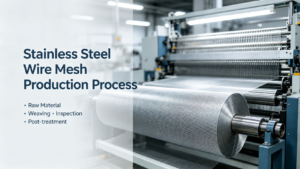
Stainless steel wire mesh is well‑known for its corrosion resistance, high strength and oxidation resistance. It is widely used in industrial filtration, screening, building protection, chemical engineering, petroleum, food processing and other industries. High‑quality stainless steel wire mesh requires strict multi‑step manufacturing procedures, and each step determines the precision and service life of the final product.
1. Raw Material Selection
The main raw materials for stainless steel wire mesh are stainless steel wires of grades 304, 316, 316L and so on.
All incoming wires are inspected for wire diameter tolerance, material composition, tensile strength and surface finish. Wires with oxidation, burrs or rust are rejected to guarantee quality for subsequent weaving.
2. Wire Pre‑processing
Raw stainless steel wires go through straightening and deburring.
Some wires are annealed to reduce hardness and improve flexibility for weaving. Surface oil and scale are removed to prevent wire breakage and surface scratches during weaving.
3. Weaving Process
This is the core procedure for stainless steel wire mesh.
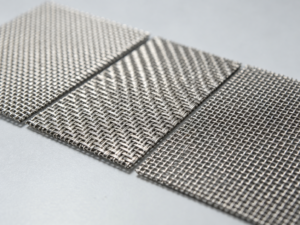
We adopt plain weave, twill weave, Dutch weave according to customer requirements.
– Plain weave: Warp and weft wires cross over and under alternately. Simple structure for general filtration and screening applications.
– Twill weave: Staggered interlacing, delivering denser mesh for high‑precision filtration.
– Dutch weave: Warp and weft wires with different diameters, achieving smaller pore sizes for fine‑filtration equipment.
Automatic weaving machines control mesh opening, wire diameter and flatness. Real‑time monitoring avoids defects such as skipped wires, mis‑weaving and distorted mesh openings.
4. Initial Inspection
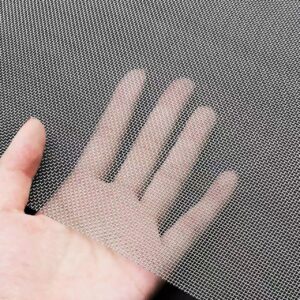
After weaving, the mesh is inspected for uniformity, broken wires, skipped wires and deformation. Wire diameter, mesh size and width are measured, and defective areas are marked.
5. Post‑treatment
1. Flattening: Remove wrinkles from woven mesh to ensure flat surface.
2. Cleaning: Remove oil and metal debris left from production.
3. Heat treatment (optional): Annealing to release internal stress and improve corrosion resistance.
4. Passivation: Surface passivation to enhance anti‑rust performance and service life.
6. Cutting & Deep Processing
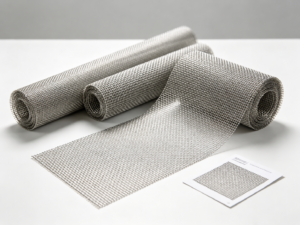
Large rolls of wire mesh are cut to required width and length. Custom processing is available: slitting, rolling, welding, edge binding, stamping and forming.
7. Final Inspection & Packaging
Full‑range quality tests are performed on finished products: mesh opening, wire diameter, tensile strength and surface condition.
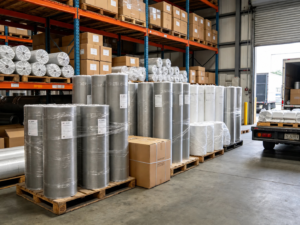
Qualified products are packed with moisture‑proof packaging, rolled or sheet‑packed with product labels for shipment.
Conclusion
Stainless steel wire mesh production follows standardized workflows. Strict control over raw material, weaving, post‑treatment and final inspection ensures stable and reliable products. We support OEM & ODM customization. We can produce stainless steel wire mesh tailored to your working conditions, mesh size, wire diameter and material requirements.