


When you start sourcing stainless steel wire mesh for filtration, screening, separation or protection projects, one of the first technical terms you will encounter is mesh count.
Many global buyers get confused: What exactly does mesh count mean? Is higher mesh count always better? How does mesh count relate to real‑world aperture size and filtration micron rating?
In this guide, we break down everything you need to know about the mesh count of stainless steel filter mesh, to help you make correct purchasing decisions and avoid costly mistakes.
What Is Mesh Count for Stainless Steel Wire Mesh?
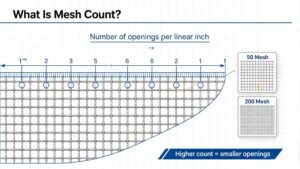
Mesh count is defined as the number of openings in one linear inch of woven stainless steel wire mesh.
For example, a 50‑mesh stainless steel mesh has 50 holes along one inch, while a 200‑mesh stainless steel filter mesh contains 200 apertures per linear inch.
Simply put: The higher the mesh count number, the denser the mesh, the smaller each individual opening. High‑mesh‑count mesh is normally used for fine‑particle filtration. Low‑mesh‑count products have bigger holes, widely applied for coarse screening, support grids, guard and protection.
(Important reminder: Mesh count alone cannot tell you the exact opening dimension. The final aperture also heavily depends on wire diameter. Two pieces of stainless‑steel wire mesh with the same mesh count can carry totally different hole sizes if the wire thickness varies. That’s why experienced industrial purchasers always check both mesh count and wire diameter.)
Mesh Count, Aperture Size and Micron Rating – What’s The Link?
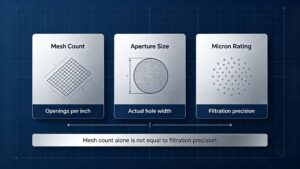
These three parameters are frequently mixed‑up by new buyers.
• Mesh count: Hole density per inch, a traditional unit widely used across global wire‑mesh markets.
• Aperture size: The actual width of each single hole.
• Micron rating: The filtration precision, the maximum particle size the mesh can retain, which is critical for liquid‑solid and gas‑solid separation.
For general‑purpose screening, customers may only reference mesh count. However, for precise industrial filtration, such as hydraulic oil purification, food‑beverage processing, chemical‑liquid filtering and wastewater treatment, you have to confirm the micron rating besides mesh count.
Our factory can provide stainless steel filter mesh from 1 mesh to 2000 mesh, including plain weave, twill weave and dutch weave mesh. Dutch weave stainless steel mesh can reach stable ultra‑fine micron grades that regular plain‑weave products cannot achieve.
How To Pick The Suitable Mesh Count For Your Application
There is no universal “best” mesh count for all projects. Your ideal specification depends on your working conditions. You can refer to our simple checklist:
1. Confirm your target particle size you hope to screen or filter out.
2. Define your medium: water, oil, acid‑alkali solution, gas or solid powder.
3. Check required flow rate. Higher open area usually brings larger flow capacity with lower pressure drop.
4. Select the weave style: plain weave for general use, twill weave for finer filtration, dutch weave for high‑precision, high‑pressure‑resistant working scenarios.
If you are not sure which mesh count fits your equipment, our engineering team can offer free‑of‑charge technical suggestions after you share your working parameters.
Common Misunderstandings About Mesh Count
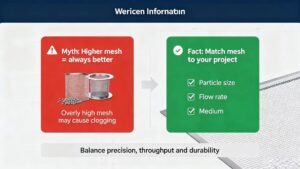
❌ Misunderstanding 1: The higher the mesh count, the better the performance.
Fact: Over‑high mesh count may cause frequent clogging, low flow speed and shorter service life. You should balance filtration precision and throughput.
❌ Misunderstanding 2: Equal mesh count means equal aperture and filtration effect.
Fact: As we mentioned before, wire diameter changes the real opening. Always ask your supplier for full datasheets including mesh count, wire diameter, aperture and micron value.

Final Tips Before You Place An Order
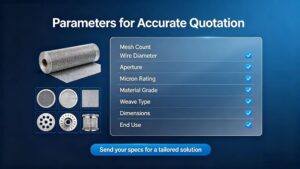
When you inquire for stainless steel wire mesh, do not only send the mesh‑count number. To get an accurate quotation, it would be much better if you could provide:
• Mesh count
• Wire diameter
• Required width & length (roll size) or custom‑cut dimensions
• Material grade: 304, 316 or 316L stainless steel
• Weave type: plain, twill or dutch weave
• End usage, working temperature and corrosive environment
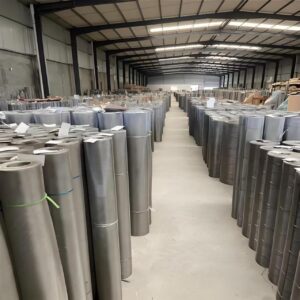
We supply standard‑roll stainless steel filter mesh as well as custom‑fabricated parts such as filter discs, strips and laser‑cut shaped pieces. We also provide material test certificates to support your import clearance and factory audit.
Get In Touch With Us
If you have any questions about mesh selection, specifications or customization of stainless steel wire mesh, feel free to send your requirements to our inbox. Our professional sales & technical team will reply within 24 hours and give you a cost‑effective solution tailored for your business.